A fair music publishing deal sits at the intersection of money, control, transparency, and exit rights. In the United States, fairness does not come from a single percentage or advance size. It comes from whether the publishing deal matches the songwriter's leverage, the publisher's actual services, and the long-term value of the catalog.
This guide explains what music publishing is, how publishing in music works, what a music publisher does, and how to judge whether a music publishing agreement is truly fair for artists and songwriters working in today's music industry.
What Is Music Publishing and What Is Publishing in Music?
Music publishing refers to the business of managing, protecting, licensing, and monetizing the copyright in musical compositions. When people ask what publishing means in music, they are talking about the ownership and exploitation of the song itself, not the sound recording. Publishing music rights covers lyrics and melody, regardless of who records the song.
Understanding what music publishing is matters because many creators confuse a music publishing deal with a record deal. A record label focuses on the master recording. A publishing company focuses on the composition. A fair music publishing deal respects this distinction and avoids giving away rights that fall outside the publishing scope.
From a legal standpoint, publishing music centers on copyright laws in the United States. Once a song is fixed in a tangible form, copyright exists, but registration strengthens enforcement and revenue collection. Many disputes in the music business start because publishing ownership was unclear at the contract stage.
What Does a Music Publisher Do?
A music publisher exists to turn compositions into revenue while protecting the songwriter's rights. At a practical level, the publisher registers songs, monitors usage, collects performance royalties from public performance, secures mechanical royalties, negotiates licenses, and pitches songs for film, television, advertising, and digital platforms.
What does a music publishing company do beyond administration? In strong deals, the publisher actively works the catalog by pitching songs, maintaining sub-publishing relationships, and enforcing copyrights globally. In weaker deals, the publisher may only collect royalties without meaningful promotion. Fairness depends on whether the services promised match the share taken from the songwriter.
What Is a Fair Music Publishing Deal: The Fairness Test
When creators ask what is a fair music publishing deal, the answer depends on five core factors: rights granted, revenue split, term length, transparency, and exit options. A fair deal involves a balance between what the publisher receives and what the songwriter keeps.
Rights must be limited to publishing music rights, not masters or unrelated income streams. Revenue splits must reflect the deal type and the publisher's role in generating income. Terms should not lock a songwriter into decades without a reversion path. Transparency requires clear accounting schedules and audit rights. Exit options ensure that if the publisher fails to perform, the songwriter can reclaim control.
Fairness is contextual. A new songwriter may accept different terms than an established writer, but the deal should still protect long-term value and creative independence.
Types of Music Publishing Deals and What Fair Looks Like in Each
Music publishing deals come in several forms. Each type carries different expectations around control and compensation.
| Deal Type | Rights Granted | Typical Economics | When It Can Be Fair |
|---|---|---|---|
| Administration deal | Publisher administers without ownership | 10–25% admin fee | When the writer needs collection support but wants to keep ownership |
| Co-publishing deal | Shared ownership between writer and publisher | Writer keeps 75% total economics | When the publisher actively pitches songs and provides creative services |
| Full publishing deal | Publisher controls and owns publisher's share | Publisher keeps 50% of publishing revenue | When a large advance and aggressive exploitation justify reduced control |
| Single-song deal | Limited to specific compositions | Split varies by leverage | When a specific placement opportunity exists |
| Exclusive songwriter deal | Covers all works during the term | Depends on advance and services | When the publisher commits long-term resources to the writer |
A fair co-publishing deal, for example, usually allows the songwriter to retain the writer's share and a portion of the publisher's share while benefiting from active promotion. Administration deals often suit independent creators who already generate revenue but want infrastructure support.
Royalty Streams in a Music Publishing Agreement
To judge fairness, songwriters must understand how music publishing works financially. Publishing deal income comes from several revenue streams. Performance royalties arise when songs are played publicly, whether on the radio, streaming platforms, live venues, or television. Mechanical royalties flow from reproductions of compositions, including streams and downloads. Sync fees result from licensing songs for audiovisual uses.
| Use of Song | Primary Royalty | Who Pays | Who Collects |
|---|---|---|---|
| Streaming | Mechanical and performance royalties | Digital services | The MLC and PROs |
| Radio play | Performance royalties | Broadcasters | PROs |
| Live performance | Performance royalties | Venues | PROs |
| Film or TV placement | Sync fee plus performance royalties | Production company and broadcasters | Publisher and PROs |
A fair music publishing contract clearly defines how these revenue streams are split, reported, and paid. Vague language often benefits the publisher at the songwriter's expense.
The Terms That Decide Whether a Publishing Deal Is Fair
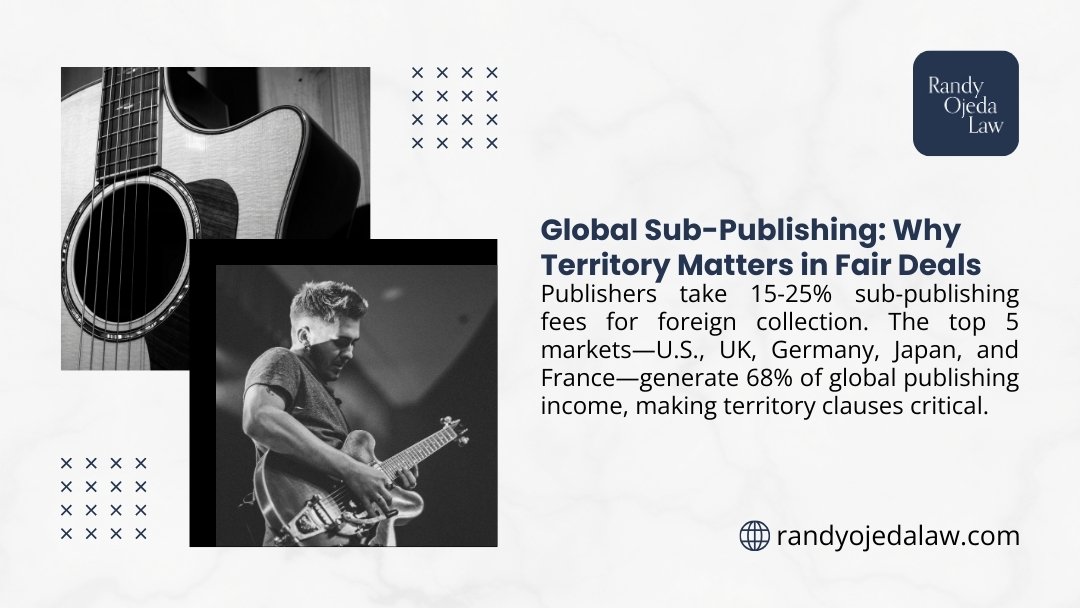
Beyond percentages, contract terms often determine whether a publishing deal remains fair over time. Term length should align with the advance and services provided. Options that allow the publisher to extend the deal unilaterally deserve scrutiny. Territory clauses should reflect the publisher's actual reach.
Accounting provisions matter. Regular statements, detailed breakdowns, and audit rights protect against underreporting. In the music publishing industry, transparency separates professional partners from passive collectors.
Advances and the Real Value of a Music Publishing Deal
Many creators ask how much a music publishing deal is worth. The answer depends on the relationship between the advance and recoupment. An advance is not free money. It recoups from future royalties before the songwriter sees additional income.
A fair advance aligns with realistic earning potential and does not require cross-collateralization that traps unrelated songs. Large advances paired with long terms and aggressive options often reduce lifetime earnings. Smaller advances with better splits can yield more value over time.
Publishing Deal vs Record Deal
A publishing deal vs record deal comparison helps artists understand why these agreements serve very different purposes in the music business and why confusing them often leads to unfair outcomes.
| Aspect | Publishing Deal | Record Deal |
|---|---|---|
| What it covers | The musical composition (lyrics and melody) | The sound recording (master) |
| Primary focus | Songwriting, copyright management, licensing | Recording, marketing, distribution |
| Who the partner is | Music publisher or publishing company | Record label |
| Main revenue streams | Performance royalties, mechanical royalties, sync fees | Streaming revenue, sales, neighboring rights |
| Ownership impact | Often shared or retained by the songwriter | Label commonly owns or controls the masters |
| Creative control | Generally remains with the songwriter | Frequently limited by label decisions |
Understanding this difference is essential because a fair music publishing deal should never quietly function like a record deal or claim rights that fall outside of publishing music rights.
How to Get a Music Publishing Deal and Keep It Fair
How to get a music publishing deal involves preparation as much as talent. Songwriters who understand their catalog's performance, register works properly, and present clear data negotiate from strength. Fair deals emerge when creators ask precise questions about services, accounting, and exit rights before signing.
Professional review matters. Many creators consult a music publishing lawyer to evaluate terms, clarify obligations, and negotiate adjustments. Getting guidance on contract review and negotiation practices helps creators avoid common mistakes before committing to long-term agreements.
Warning Signs of an Unfair Publishing Deal
Unfair publishing deals often share patterns. Overly broad rights, unclear royalty definitions, and vague “reasonable efforts” language limit accountability. Restrictions on audits or infrequent accounting statements reduce transparency. Excessive options that extend control without new consideration undermine balance.
Final Thoughts
A fair music publishing deal is not defined by hype or tradition. It reflects clear rights, reasonable economics, honest accounting, and an exit path that protects the song's future. Creators who understand what music publishing is, how publishing deals work, and how publishers earn their share make better decisions and keep more control over their careers.
Before signing any music agreement, an informed review remains the safest step. Artists and songwriters seeking clarity often speak with counsel experienced in music contracts, royalty structures, and copyright protection. For creators ready to move forward, connecting with a qualified music publishing lawyer through a direct consultation offers clarity before commitment.