Every year, thousands of artists in the United States lose their brand rights because their stage names were never registered. If you're serious about your music career, knowing how to trademark your rap name is your best defense against imitation and legal disputes.
The process involves performing a USPTO trademark search, filing an official TEAS application (costing $250–$350 per class), providing valid specimens, and maintaining ownership through renewals every ten years.
While the USPTO handles over 450,000 trademark applications annually, many are delayed or refused due to small filing errors, something an experienced music lawyer can prevent.
Below, you'll learn how to trademark your rap name step-by-step, the cost, proof requirements, differences between trademark and copyright, and how professional legal guidance speeds up registration and protects your creative identity.
How to Trademark Your Rap Name: Step-by-Step Roadmap
Before your brand takes off, file your rap name as a registered trademark. The USPTO (United States Patent and Trademark Office) allows you to secure exclusive nationwide rights, provided your name is distinctive and actively used in commerce.
1. Run a USPTO Trademark Search
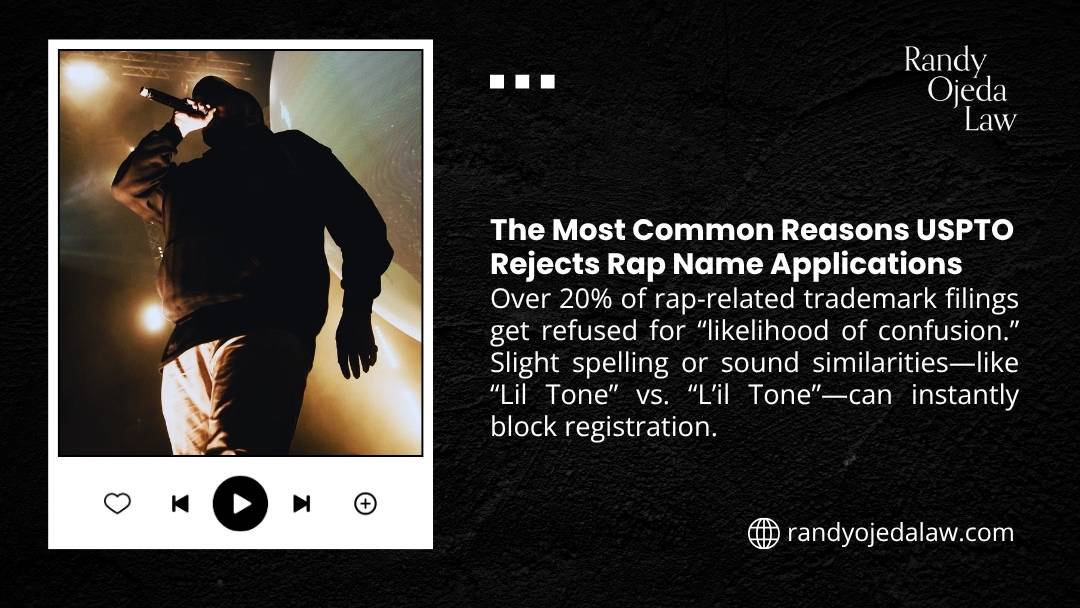
Start with the official USPTO Trademark Search (previously TESS). Search identical and similar marks under Class 41 (entertainment services) and Class 25 (clothing). Names with a similar sound or spelling may block your registration. Over 20% of new filings are refused for the likelihood of confusion, so a proper clearance search is crucial.
2. Choose the Correct Filing Basis
Use in Commerce (Section 1a):You're already releasing music or performing live.
Intent to Use (Section 1b): You plan to use your name soon.
Choosing the wrong basis leads to costly amendments. Many first-time filers pay $100–$200 in surcharges after selecting the wrong filing type.
3. File Through TEAS Plus or TEAS Standard
The TEAS Plus form costs $250 per class, while the TEAS Standard costs $350. The Plus option has stricter ID Manual requirements but avoids delays. Each additional class (like merch or digital music) adds a separate fee.
4. Respond to USPTO Office Actions Promptly
About 35% of applications receive office actions, often for missing consent forms, unclear specimens, or conflicting marks. If you receive one, reply within six months to keep your application alive.
5. Wait for Publication and Registration
Once approved, your name is published for 30 days in the USPTO Gazette. If no one opposes, your registration certificate will be issued, on average, 12–18 months after filing.
| Step | Average Cost (USD) | Processing Time | Notes |
|---|---|---|---|
| Trademark Search | Free or $50–$300 (professional) | 1–2 days | Avoids refusals |
| TEAS Plus Filing | $250 per class | Instant submission | Lower cost, strict wording |
| TEAS Standard Filing | $350 per class | Instant submission | Flexible descriptions |
| Office Action Response | $0–$500 | 3–6 months | Common for consent/specimen |
| Registration Certificate | Included | 12–18 months total | Valid for 10 years |
For a smooth process, consider early legal review through an experienced music lawyer.
What Counts as Proof for a Rap Name
Your proof, or specimen, is what convinces the USPTO that your name isn't just an idea. It shows your mark is used as a brand, not just a song title.
Valid specimens include:
- Flyers, posters, or concert pages showing your rap name as a performer
- Spotify or Apple Music profiles linking your name to services (not songs)
- Clothing tags or eCommerce product listings displaying your name as a logo
If your stage name matches your legal name, include a consent statement ("I, [Artist Name], consent to the registration of my name as a trademark") to avoid automatic refusal.
| Specimen Type | Accepted For | Common Rejection Reason |
|---|---|---|
| Live show posters | Class 41 (services) | No date or contact info |
| Streaming platform profile | Class 41 | Shows album title, not brand |
| Clothing label or store listing | Class 25 | Missing mark on tag |
| Website promo page | Class 41 or 35 | Generic description, no mark |
| Signed consent form | All | Name mismatch |
When in doubt, consult a music lawyer for rappers to prepare the right proof and avoid refusals.
How Do I Run the Search and File Without Traps?
Many artists search for how to trademark your rap name and end up overwhelmed by jargon: "classes," "TEAS," "SOU," and "ID Manual." Here's what truly matters:
- Check Similar Names:Search the USPTO database by spelling, sound, and meaning. Even small variations can block you (example: "Lil Tone" vs. "L'il Tone").
- Review Abandoned Filings: Look for similar names that failed registration; these can resurface as conflicts.
- Use the ID Manual: This list defines acceptable product/service descriptions. Using the wrong wording can lead to a $100 per-class correction fee.
- Pick Your Classes Wisely: Music and live performances fall under Class 41, while apparel belongs to Class 25. Avoid unnecessary filings that inflate your costs.
- Track Status:Use the USPTO's TSDR portal to follow progress. Applications with no response after 90 days move into review.
Professional help through a music contract review lawyer or a music contract negotiation lawyer can save time, especially when your mark ties to upcoming label or distribution agreements.
Trademark vs. Copyright: The Real Difference for Artists
Both protect creative work but serve different purposes. A trademark guards your brand identity (name, logo, slogan), while a copyright protects your creative content (lyrics, beats, recordings). Confusing them can limit your rights or double your filing fees.
| Feature | Trademark | Copyright |
|---|---|---|
| Covers | Name, logo, brand identity | Lyrics, beats, sound recordings |
| Filed With | USPTO | U.S. Copyright Office |
| Cost | $250–$350 per class | $45–$65 per work |
| Protection Duration | Indefinite (with renewal) | Life of author + 70 years |
| Scope | Nationwide brand rights | Artistic content rights |
| Proof of Use | Specimens (ads, merch, posters) | Published or recorded work |
| Typical Filing Time | 12–18 months | 3–6 months |
| Renewal | Every 10 years | None (automatic after creation) |
For music copyrights, see resources on how to copyright your music, how to copyright an album, or check the typical costs in music copyright registration.
Clearance to Registration: A Connected Legal Plan
Trademarking your rap name doesn't end with a USPTO certificate. The real value lies in aligning your contracts, royalties, and licensing under one ownership structure.
For instance, if you sign a record deal or distribution agreement before registering your name, the label might claim partial ownership of your trademark. Having a registered mark in your LLC's name secures full control of merchandising and branding profits.
Important Statistic
According to the USPTO, over 11% of entertainment marks face ownership disputes within five years of registration. To avoid that, coordinate your contracts with an attorney familiar with music intellectual property law.
| Key Legal Area | Why It Matters | Recommended Action |
|---|---|---|
| Contract Negotiation | Determines who owns the mark | Consult a music label lawyer |
| Licensing Agreements | Allows use by brands or sponsors | Use a music licensing lawyer |
| Publishing Rights | Controls royalties and credits | Work with a music publishing lawyer |
| Royalty Tracking | Prevents lost income from streams | Contact a music royalty lawyer |
| Trademark Ownership | Protects your brand in contracts | File under your LLC name |
| Ongoing Counsel | Manages renewals and disputes | Counsel for Creatives |
You can explore flat-rate legal plans and transparent pricing through Randy Ojeda Law's pricing page.
Extra Resources for First-Time Filers
If this is your first time filing a trademark, remember that more than 60% of first-time applicants at the USPTO are independent creators navigating the process on their own. The system may seem complex, but it's manageable once you understand the right order: search, file, prove, and protect.
Artists who file early prevent costly disputes later, especially when a stage name begins gaining traction online.
Key Statistics for Artists
- • About 70% of independent artists wait until after releasing their music to file for trademark protection
- • One in five filings face opposition or procedural delays that could have been avoided with early legal advice
- • Florida currently ranks among the top ten U.S. states for creative trademark filings
In Florida, creative businesses and artists benefit from working directly with an entertainment lawyer in Tampa who can register trademarks, set up LLCs, and handle legal formalities under one roof.
If you plan to release new music or sign a label deal soon, this is the right moment to secure your brand. Get started with Randy Ojeda Law, a Tampa-based music lawyer for rappers who represents clients nationwide in entertainment law, copyright, licensing, and brand protection.
Visit the contact page or explore Randy Ojeda Law to schedule a consultation and lock in ownership of your rap name before it reaches global platforms.